I was born in a special period of history when my dad was the assistant manager of Roses, a regional discount department store serving mostly the Carolinas and Virginia. All over America, K-Mart was “the savings place” for every living consumer, while the sheer dominance of existing chains Target and Walmart didn’t take shape until two decades later. Amazon never existed at all because it was online only and nobody was using the Internet while Jeff Bezos was just a boy. At the same time I was born, W.T. Grant was going out of business in what was during 1975-76 the largest retail bankruptcy in American history.
There has always been an abundant supply of brick n’ mortar stores going after our dollars and cents as consumers had plenty of big money-saving deals to fetch. Those ads on TV and in print with all the sale prices were designed for us to take advantage of them “for a limited time only”. But with everything too saturated in the retail market where department stores kept you coming back, is it any wonder why these five “dead” retailers I am about to show you were victims of dog-eat-dog competition, shifting consumer habits, and bad business decisions.
I’ll have to admit that I’m a sucker for reliving dead retail stores through a time warp. YouTube clips and old ad snippets provide a visual record of retail history. And I wasn’t surprised to watch these vacant buildings rot for exorbitant amounts of time before turning into rubble. I also did not expect for this post to be very lengthy because I wanted this to provide some indispensable details about life’s past. I would have documented these things but apologies for the lack of photographs; me and my family never had the chance to film all of this. And always remember, everything I write about on this blog is based on years of research and recollective memories…
KORVETTE’S
E.J. Korvette is an example of a defunct department store, only that I recall looking at the unremoved signage on the building and attached to a shopping mall. Many of its grand openings were often met with high amounts of fanfare. This one was in the city of Hampton, Virginia, by the way. Looking at an old news clip, it appeared this shuttered location had three different entrances including access from the city’s now-former Coliseum Mall wing. It was one of many sightings during my early 80s boyhood on my parents’ joyrides near the mall. Not in my collective memory as a preschool kid have I been inside a Korvette’s, but I was much too young to know. I often wonder why stores that went out of business long ago still retained signage on the buildings. Korvette’s? Never heard of ‘em. And it sounds like a sports car!
The chain was once among the chief pioneers of undercutting MSRPs, hence the “discount retailer” of its time with under 60 stores in the eastern USA including a signature location in New York City. Even the founder of the company made the cover of Time magazine in 1962! (coincidence, eh?) There was anticipation that the retailer would rise to stardom but internal problems would hurt its future growth prospects. Korvette’s was completely liquidated right before the Christmas of 1980, leaving us with yet another footnote of retail history that was highly influential.
Upon further research, I’ve learned that the store’s greatest cool factor was its expertise in selling music and electronics; they had one heckuva selection of music LPs and had been involved in developing audio equipment. Chances are if it’s still got a Korvette’s (or any other defunct store’s) price sticker intact without fading off, it’s worth the memorabilia.
ZAYRE
Zayre in Portsmouth, VA was where I bought my very first VHS movies. This was one of the few department stores that included an auto service center… convenient! Right in front on the very same parking lot was the Golden Goat recycling machine… even more convenient! My parents liked the remodel of the store and the appealing selection of merch — that’s orange appeal, I must add. Now, that very same store is a site for go-kart racing, putting the empty building to good use.
There were some memorable times of being at Zayre: one, the snack bar promoted an offer where if you showed off your report card and made the honor roll, you’d get a free hot dog meal — score! Another was when my family was eyewitness to a shoplifting; a man was dashing out of the store carrying a large box containing what might have been a VCR, and the associates were all out there watching in disbelief.
A vast majority of Zayre stores were bought out by Ames in 1988, with all of its remaining stores not converted to the latter closing doors for good by 1990. Sad to see a good store disappear that way. Long before, it operated TJ Maxx and BJ’s Wholesale Club as part of its retail portfolio, both still in business today under its successor name TJX.
AMES
When this discount chain made its anticipatory arrival in my town after buying out G.C. Murphy in 1985, I was looking forward to a whole lot more. Ames had originally been a staple in smaller, less densely populated towns and suburbs, so they sought after nationwide expansion and became a rising contender… for a while. It brought out a very contemporary layout and a wide assortment of products with competitive prices versus discount champ Roses. All of this wasn’t built to last, however. I’m not sure whether Ames had anything different to set it apart from the competition or not. What I do know is Walmart arrived next door in the early 90s, and it was lights out for the retailer. In terms of demographics, stores like Ames in my local area just didn’t turn out to be the right fit after all.
At one point, Ames was ranked fourth among the largest discount department stores in the United States. Around 1989, the retailer that originated from a small town in Connecticut rolled out a major TV ad campaign under the heartwarming tagline “we grew up with better values”. Analysts point out that Ames’ takeover of Zayre led to its business decline with a resulting Chapter 11 bankruptcy. After reorganization, Ames purchased the Hills chain and history repeated itself once again, this time with a Chapter 7 up until its demise in 2002.
As recently as 2023, there were unconfirmed reports about Ames making a comeback by opening new stores in its once-native Connecticut. The following year, it was speculated on an “official” Ames website that up to 35 new locations would open starting in 2026, but if Snopes is correct, then this is most definitely a hoax of a business news story. It was brought up by a company that owns residual assets of Ames, and that’s not even true, either. Someone must have pulled off a lousy April Fools prank on unsuspecting longtime fans who had plenty of admiration with the long-defunct Ames branding.
ROBERT HALL VILLAGE
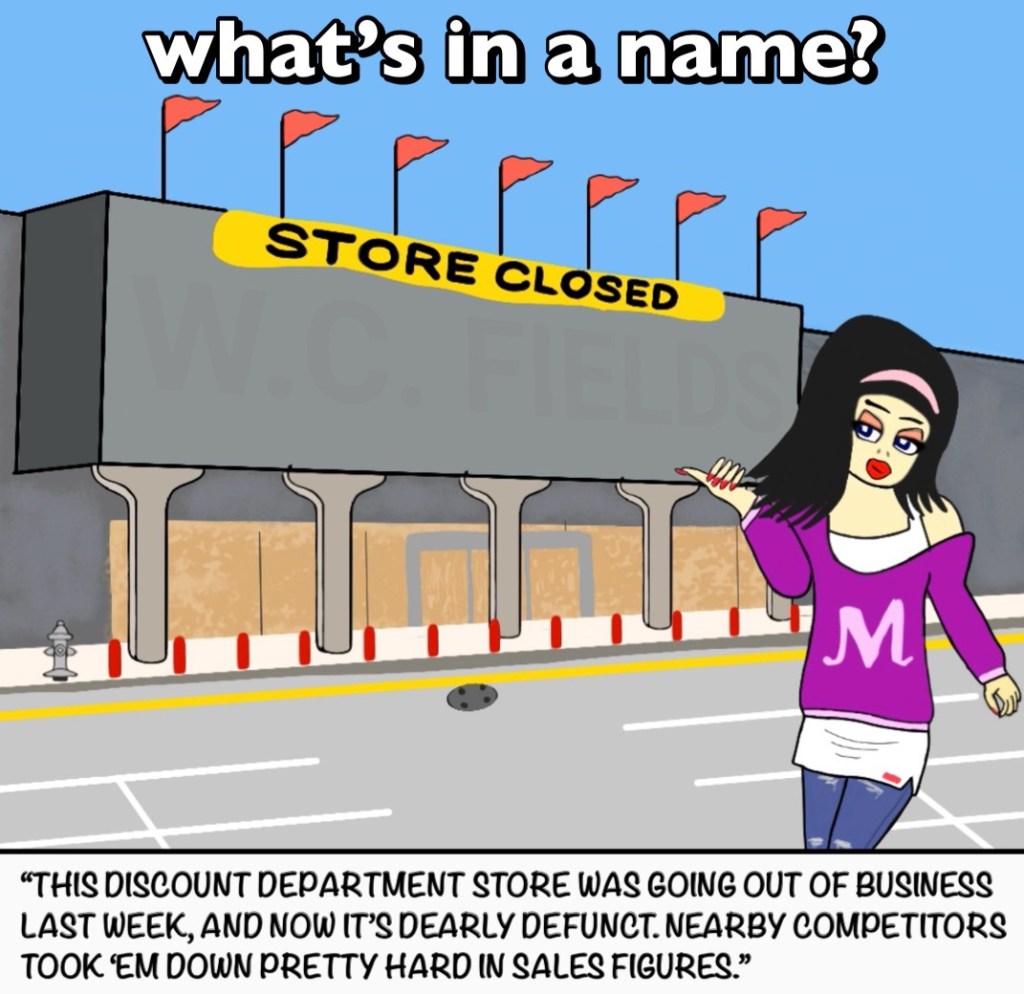
This one is the most infamy-ous of the dead retailers on my list of the Fallen Five. Robert Hall, not an actual person mind you, was a trailblazer of the “big box” clothing store established in the late 1930s and was notable for its large-scale inventories of mens suits and sportcoats. However, its parent company United Merchants filed for bankruptcy in 1977 and ceased operations all too abruptly. Its short-lived ‘Village’ format was inaugurated four years prior to its demise. This was an attempt to become another K-Mart by merging its mass clothing inventory with mass general merchandise you’d also find in a K-Mart. It’s probably worth theorizing these stores were laid out in an upscale fashion, like Target.
Staying with me so far? Good, because I have a story to tell you. As a child riding in the back seat of my parents’ Ford Fairmont during the early 80s when we sneak out to the mall or off to Grandma’s house, I often glance over the window wondering how these places ever existed at all. Those empty boarded-up Villages were among the worst examples of economic blight out in the wide open for all the motorists to see. I’ve actually spotted two or three of them, particularly if you ventured out in the Tidewater / Hampton Roads, Virginia area. Robert Hall must have been looking for a designated market to build these Goliath sized big boxes in poorly located areas zoned for commercial use. Most often, these stores were attached to a grocery tenant as it was perfectly ideal. The one in Portsmouth (again), a populous city once known as a vacant retail wasteland for quite some time, had been a monumental landmark as of 2001. That was the last year I passed through the area right after watching the demolition of distant childhood memory Tower Mall and stopping at a bakery thrift store nearby. Situated right beside a Gwaltney meat facility in a vast field of patchy looking pavement full of weeds and attached to a former A&P then Super Fresh, it sat there shuttered and inoperable for three decades until finally facing the bulldozer (est. 2005-2007) for a new Food Lion development. Why, they could have actually started a cornfield and raising cattle right on top of it a whole lot sooner! Field Of Dreams, am I wrong? When I see this building across the road with the signage intact just standing directly from Burger King’s outdoor playground circa 1985, I’m asking myself “WTF???”.
Maybe my parents shopped at this place before, and I was only a toddler riding around in a stroller — who knows when and where? Anyhow, a certain number of ‘Village’ stores were either converted into K-Marts or left totally abandoned in a total state of decay, not surprisingly. There are some YouTube clips about a K-Mart in nearby Chesapeake that was previously a Village — it was also the next-to-last store in the state of Virginia. Now I get SOME idea of what those were like… they must have been designed with elegance in mind like all the fancy clothes they sold, but man, talk about square feet of excess! No wonder…
A&P
Oh, the almighty A&P! It’s a sad reminder that longevity in business doesn’t last. It’s even sadder when it was the Walmart of its century-old prime. Famously known for its Eight O’ Clock Coffee brand, this legendary company known as the Great Atlantic And Pacific Tea Company was established in 1859. It laid out the foundation for serving the consumer with its small friendly and neighborly shops numbering 15,000 at its peak. They were mainly situated in downtowns and urban areas across the country. By the mid 20th century, it expanded the square footage to accommodate wider selections. Many stores built in the 1960s-early 70s featured a symbolic design with a centennial architecture and steeple.
As a child, it felt like A&P was a very welcoming, and sometimes very classic grocery shopping experience. The one in my town that opened in the 1960s wasn’t large at all, and it never had public address speakers playing Muzak. It was just a simple basic grocery store with the rich aroma of its trademark coffee on aisle four. Me and mom would go say “hi” to the butcher doing his thing in the meat department.
Newer competition in the form of Big Star, Safeway and Winn-Dixie with deli and bakery offerings created a grocery store boom in the 1970s, and with that came rising pressure on a now-downsized A&P that was evident in any town across America. In other words, it was facing obsolescence. A&P would later run a vast number of chains such as Waldbaums, Food Emporium, and Farmer Jack while deploying a new name to its Mid-Atlantic division as Super Fresh in an effort to stay profitable. Changing dynamics in the grocery business and the buildup of Walmart stores (and to much lesser extent K-Mart and Target) turning into supercenters only exacerbated the agony of A&P, now being reduced to a regional outfit originally born out of New Jersey. The long legacy of a coffeemaker turned food store that ran for more than a century and a half came to a complete stop in 2015 as all stores were liquidated, shut down, and wiped off the face of the earth.
There has got to be a documentary feature film about A&P someday because it’s so rich in its history that it is part of the American fabric. Old photographs that exist would paint a fascinating picture of what used to be America’s biggest retailer that is now all but unknown in the minds of today’s generation. But you can still order Eight O’ Clock Coffee from the official online store, the last surviving remnant of what A&P stood for.
I haven’t even begun to cover Bradlees, Phar-Mor, Service Merchandise, and countless others to mention — never really heard of Caldor or Jamesway since they weren’t in my geographical region — so I’m saving the next wave of mothballed stores for Part Two. With a collective memory like mine, it’s important to share whatever artifacts history has brought us. You might have something in the attic with a price tag coming from a store that went out of business. Or, all you do is remember and tell all about it.
 Jasimo’s Blog
Leave a comment